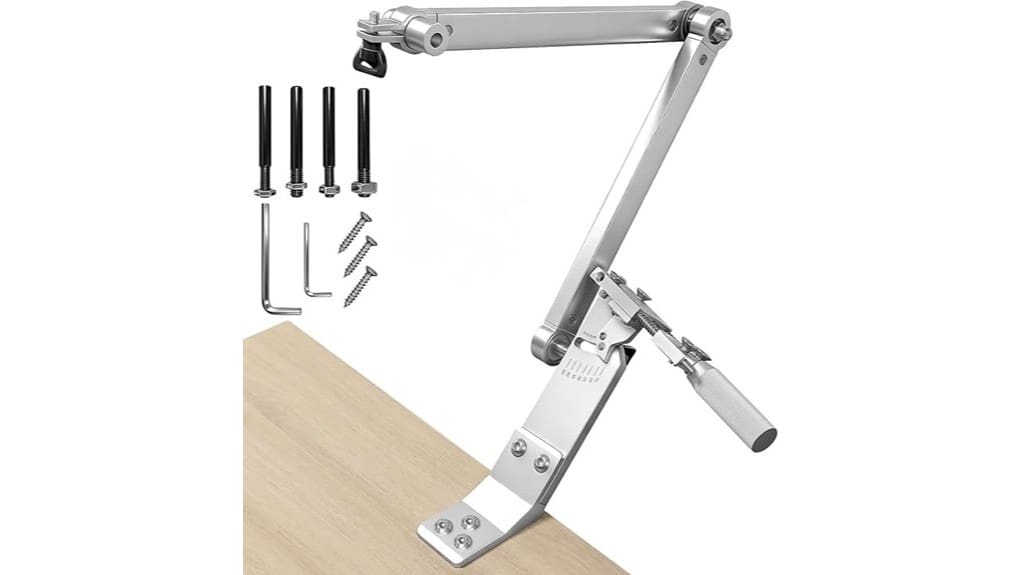
You’ll get a compact, bench-mounted jig that clamps mower blades firmly and lets you set repeatable bevels from 15° to 45° for straight, mulching, high‑lift, and left/right blades. It bolts to a workbench, uses grinder bushings and a bearing system to cut vibration, and the thumb‑screw adjustments make quick, consistent passes with minimal material removal. It’s ideal if you service multiple mowers; keep fasteners checked and expect to learn setup, safety, and alternative options further on.
Some Key Takeaways
- Adjustable 15°–45° jig clamps blades securely, enabling repeatable bevels for straight, mulching, and high‑lift blades.
- Sturdy bench‑mount design with grinder bushings and five adapter screws ensures compatibility and minimal vibration.
- Ball bearings and reinforced clamp reduce wobble and heat, preserving balance and edge geometry during sharpening.
- Quick angle changes via thumb screws and indexed setup make batch sharpening efficient for homeowners and small landscapers.
- Best for frequent service and shared workshops; not ideal if you only sharpen blades once yearly or lack bench space.
What the 15°–45° Adjustable Sharpener Is and Who It’s For
Because you need clean, balanced edges without buying multiple tools, the 15°–45° Adjustable Sharpener gives you a single, workshop-mounted solution that adapts to straight, mulching, high-lift, and both right- and left-hand mower blades. You’ll find a compact, durable jig that clamps blades securely, uses a grinder bushing for precise angles, and reduces vibration for repeatable results. It’s for DIY homeowners, small landscapers, and shop technicians—user demographics who value consistency and efficiency. You’ll use it to standardize blade maintenance, cut downtime, and build shared confidence in equipment care across your crew or neighborhood group. Regular blade sharpening is an essential part of home lawn care that helps maintain cutting performance and turf health.
How Setup Works: Mounting, Grinder Adapters, and First-Time Adjustments
When you unbox the sharpener, start by mounting the jig to a sturdy table or workbench using the pre-drilled holes so the unit sits flat and immobile; this fixed position keeps the grinder and blade aligned for consistent edges. Use basic mounting techniques—short bolts and lock washers—to prevent micro-movement. Confirm grinder compatibility with the supplied five adapter screws and fit the correct bushing. Perform initial calibration: set the blade holder angle, hand-tighten thumb screws, and index a test blade. Finish with safety checks: clamp integrity, bearing spin, and guarded grinder operation before first cut. Many homeowners find a sharpening stone handy to maintain a razor edge between full regrinds.
Sharpening Test Results: Angle Range, Ease of Use, Balance, and Vibration Control
With the jig securely mounted and initial calibration complete, you can evaluate performance across angle range, ease of use, blade balance, and vibration control. You set angles from 15° to 45° using the thumb screws; adjustments are quick and repeatable, giving consistent bevels for straight, mulching, and high-lift blades. Blade alignment stayed true during passes, minimizing material removal. Balance checks showed even edge geometry and reduced wobble. Vibration control impressed: the bearing system and clamp delivered effective noise reduction and steady contact, so you maintain control during extended sessions and join others who prefer reliable, efficient sharpening. The unit is especially helpful for homeowners who maintain their property regularly and need consistent sharpening without professional service.
Build Quality and Safety: Bearings, Clamping, Handle, and Long-Term Durability
Although small parts often dictate long-term reliability, the sharpener's core hardware — bearings, clamp, and handle — is built to hold up under repeated use. You’ll find a high-quality ball bearing system that reduces wobble and heat; regular bearing maintenance (cleaning and light lubrication) keeps tolerances tight. The reinforced clamping mechanism secures blades without slipping, so you won’t babysit the setup. The enlarged, slip-resistant handle improves control and handle ergonomics for extended sessions. Materials and fitment feel robust; fasteners and thumb screws resist loosening. Overall, durability and safety are engineered for frequent, confident use in a shared shop. Consider pairing the sharpener with equipment covers to protect other tools and extend their service life.
Should You Buy It? Use Cases, Limitations, and Best Alternatives
If you regularly service multiple mowers or want workshop-grade consistency, this sharpener gives you fast, repeatable edges and solid clamping that save time and reduce blade imbalance. You should buy it if you need a single, durable jig that fits most angle grinders, handles right- and left-hand blades, and mounts to a bench for repeatable setups. Limitations: not ideal if you only sharpen once yearly or lack bench space. For budget buyers or portability, compare cost comparison figures and read user testimonials. Best alternatives include portable manual sharpeners and dedicated motorized bench sharpeners with integrated guides. This tool is especially useful for homeowners who maintain multiple machines and need reliable replacement blades management.
Some Questions Answered
Can It Sharpen Non-Mower Garden Tools Like Axes or Hoes?
No — you shouldn’t use it for axe sharpening or hoe maintenance. The jig’s clamp, angles, and grinder adapters are optimized for mower blades; axes and hoes have different bevel geometry, thickness, and heat‑tolerance. Trying to sharpen them risks poor edges, damaged tool or sharpener, and unsafe vibration. Use a dedicated axe/hoe file, grinder jig, or whetstone system designed for hand tools to get proper bevels and maintain safety and community standards.
Are Replacement Adapter Screws Available Separately From the Manufacturer?
Yes — you can get replacement screws from the manufacturer; contact customer support to order them. They'll confirm compatibility with your adapter set and advise on quantities, shipping, and fit. You’ll receive genuine replacement screws sized for the five adapter positions, preserving secure mounting and safe operation. If you’re part of their user community, they’ll help fast and practically so you’re back to precise, vibration-free sharpening quickly.
Does the Sharpener Fit Left-Handed Users' Workflow Comfortably?
Yes — you’ll find it fits left-handed workflow comfortably. The ergonomic handle’s enlarged, slip-resistant grip gives you confident control, and the reinforced clamp plus ball-bearing system stabilizes blades for safe reverse mounting. Thumb screws let you set mirror angles quickly, so lefties can maintain the same precision as righties. You’ll feel included in the design: it’s practical, repeatable, and built for consistent, vibration-free sharpening.
Can It Be Used Safely Without Mounting to a Bench?
Yes — you can use it safely without bench mounting if you follow safety tips and make certain portable stability. Clamp the sharpener or grinder in a secure vise, stabilize the workpiece, wear eye and hand protection, and keep clear work area. Use the reinforced clamping mechanism and ball-bearing control to minimize vibration, maintain firm grip on the enlarged handle, and test at low speed first. Share tips and help others stay safe.
Is There a Recommended Grit or Disc Type for Different Blade Steels?
Yes — pick abrasives by steel hardness: use a coarse disc (60–80 grit) for nicked or very hard blades, then switch to fine grit (180–320) to refine the edge; for hardened or stainless steels consider a diamond disc for initial material removal and a fine grit to finish. You’ll get consistent results if you match disc aggressiveness to steel, work steadily, and share tips with fellow users to build confidence and consistency.