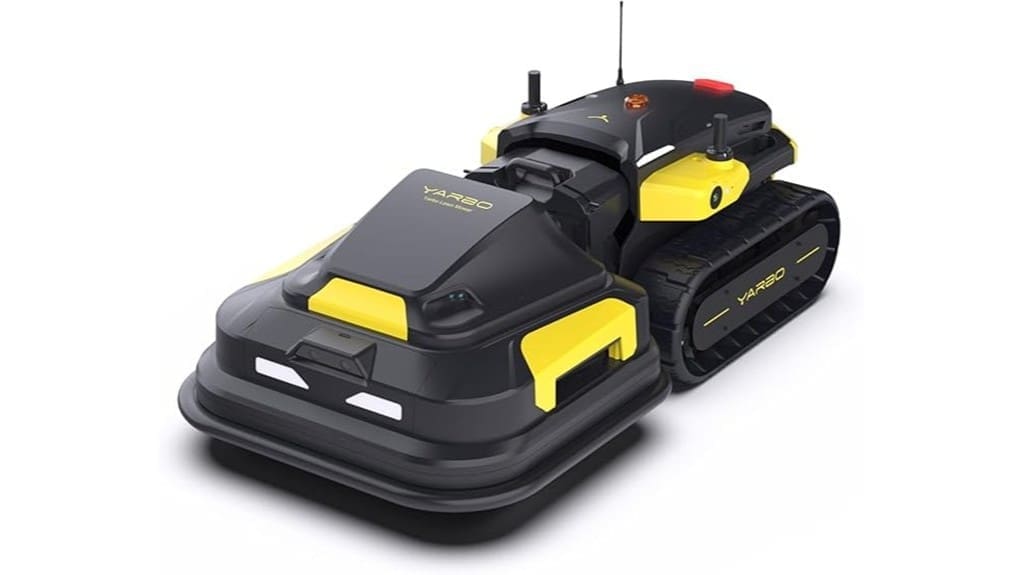
You’ll get tractor‑style power and precision in a compact, modular robot that’s built to handle large yards, steep slopes, and year‑round tasks without constant supervision. It runs up to 120 minutes per charge, maps and zones with RTK or vision, and covers about 0.25 acre per cycle while managing up to 6.2 acres overall. Tracks give superior traction on inclines and rough ground, modules add versatility, and the premium cost can pay off—keep going to see detailed tradeoffs and setup realities.
Some Key Takeaways
- Up to 120 minutes runtime per charge, covering about 0.25 acre per cycle and managing up to 6.2 acres with multiple cycles.
- Tracked all‑terrain chassis provides superior traction, stability, and slope performance up to a 70% grade.
- RTK navigation and vision mapping enable centimeter-level repeatability and app zoning, though RTK needs clear sky and precise base placement.
- Modular design supports swapping mower, leaf, and snow modules for year‑round use, but modules add cost and weight.
- Premium upfront cost offsets long‑term landscaping savings for large properties, with ongoing battery, module, and maintenance expenses.
How the YARBO Robot Handles Big Yards: Range, Runtime, and Coverage
While the YARBO robot looks built for large properties, its real strengths are the blend of long runtime and high coverage: you’ll get up to 120 minutes per charge and capacity to manage as much as 6.2 acres (25,000 m²), with each cycle covering roughly 0.25 acre. You’ll appreciate its battery management: a 38.4 Ah pack that supports multiple charge cycles without frequent swaps. Compared to perimeter-wire systems, perimeter alternatives like RTK vision reduce setup time and let you use coverage mapping in the app to zone and schedule efficiently. Overall, it balances runtime, mapping, and low maintenance. Our store focuses on helping homeowners choose the best battery mower for regular property upkeep, including models suited for larger yards and battery lawn mowers.
Terrain Test: Slopes, Uneven Ground, and All‑Terrain Track Performance
Because the YARBO uses patented all‑terrain tracks and RTK-guided navigation, it tackles steep slopes and irregular surfaces far better than wheeled robots, and you’ll notice that stability and traction remain consistent up to the stated 70% grade. You’ll find its low center of gravity and broad contact patch resist tipping and wheel slip on inclines and in ditches. Compared with wheeled units, YARBO maintains forward momentum on loose soil and wet grass. Track durability held up under abrasive gravel tests, showing minimal wear. Obstacle clearance is moderate—good for rocks and roots but limited for very tall debris. It’s an appealing option for homeowners managing larger properties who want to simplify yard care with robotic mowing solutions.
Navigation, Setup, and App Controls: RTK, AI Vision, and Installation Realities
After observing how the tracks handle slopes and rough ground, you’ll notice navigation becomes the limiting factor for precision mowing rather than traction. You’ll evaluate RTK setup against AI vision: RTK gives centimeter-level repeatability but needs clear sky and precise base placement, while vision excels in obstacle recognition but falters under dense foliage. Expect Installation challenges—heavy crates, two adults, and careful Data Center positioning. In the app you’ll manage maps, no-go zones, and scheduling, but App permissions can block features until granted. Vision calibration steps are straightforward yet critical; skip them and mapping accuracy drops noticeably. Regular carburetor maintenance improves engine start reliability and longevity, especially for seasonal storage carburetor care.
Modular Use and Seasonal Value: Mowing Plus Leaf and Snow Modules Explained
If you want a single machine to handle yard chores year-round, the YARBO’s modular design lets you swap from the 20″ mower deck to leaf- and snow-blower modules, turning one platform into three specialized tools. You’ll appreciate seasonal versatility: one base unit covers mowing, leaf clearing, and snow removal, reducing storage and duplicated powertrains. Module swapability is straightforward but modules sell separately, so budget accordingly. Compared to owning three dedicated machines, YARBO cuts footprint and simplifies controls via the same app and chassis. Assess terrain and weight handling—modules add mass but keep the same all-terrain mobility and slope capability. This makes the YARBO a practical fit for homeowners who want easy lawn care with minimal equipment clutter.
Is It Worth It for Large Properties? Cost, Maintenance, and Final Verdict
While a YARBO can handle large properties—covering up to 6.2 acres with a 120‑minute runtime and 0.25‑acre cycles—you’ll need to weigh purchase and ongoing costs against the savings from automation. You’ll pay a premium upfront for the tracked chassis, RTK navigation, and modularity, but you may cut landscaping bills and storage needs. Estimate long term costs including battery replacement, module purchases, and occasional repairs. Follow a strict maintenance schedule for blades, tracks, and sensors to preserve performance on slopes and rough terrain. Verdict: if you value time, safety, and year‑round versatility, it’s a justified investment. For homeowners, consider how a riding mower integrates with your overall lawn care routine.
Some Questions Answered
Does It Require Professional Maintenance or Software Updates Subscription?
No, you don’t need mandatory professional maintenance or a paid software subscription. You’ll handle routine upkeep (blade checks, cleaning) yourself; warranty specifics come from the manufacturer and Amazon’s voluntary 30-day return. Software updates are provided but check the update cadence—likely periodic OTA updates tied to the app/RTK Data Center. For complex repairs or calibration you might prefer a pro, but basic service and updates are user-manageable.
Can It Operate Safely Around Pets and Children Unattended?
No — you shouldn’t leave it unattended around pets and children. The mower improves pet safety with sensors and AI vision, but limited sensor range and 120° sky view needs create gaps compared to boundary-wire systems. For unattended operation you’ll still face liability concerns if a child or pet enters the work zone. Supervised use or strict no-go zones in the app reduces risk and helps mitigate legal exposure.
What Noise Level (dB) Does It Produce During Operation?
The mower’s operational decibels aren’t specified in the provided specs, so you can’t confirm exact dB output; expect typical battery mowers around 60–75 dB. You should compare that to gasoline mowers (often 85–100 dB) and assess hearing safety accordingly. If you need precise numbers for local regulations or prolonged exposure limits, request manufacturer data or measure on-site with a sound meter before routine unattended operation.
Are Replacement Blades and Parts Readily Available Locally?
Yes — spare availability is generally good, but it varies by region. You’ll find blades and common parts through YARBO’s channels, major online vendors, and some local dealers; vendor compatibility is decent for modular components but proprietary modules and RTK/data-center parts may be limited. Compare sources: OEM gives guaranteed fit, third-party sellers cost less but risk mismatch. You should check local dealer stock and online OEM listings before buying.
Does It Support Voice Assistants Like Alexa or Google Assistant?
No — it doesn’t natively support voice control via Alexa or Google Assistant. You can control it through the app and RTK/Data Center features, but there’s no built‑in smart speakers integration. Compared to some rivals offering direct voice assistant hooks, YARBO relies on app/RTK navigation and remote commands. You could potentially bridge controls with third‑party home automation routines, but that’s more complex and less seamless than native voice assistant support.