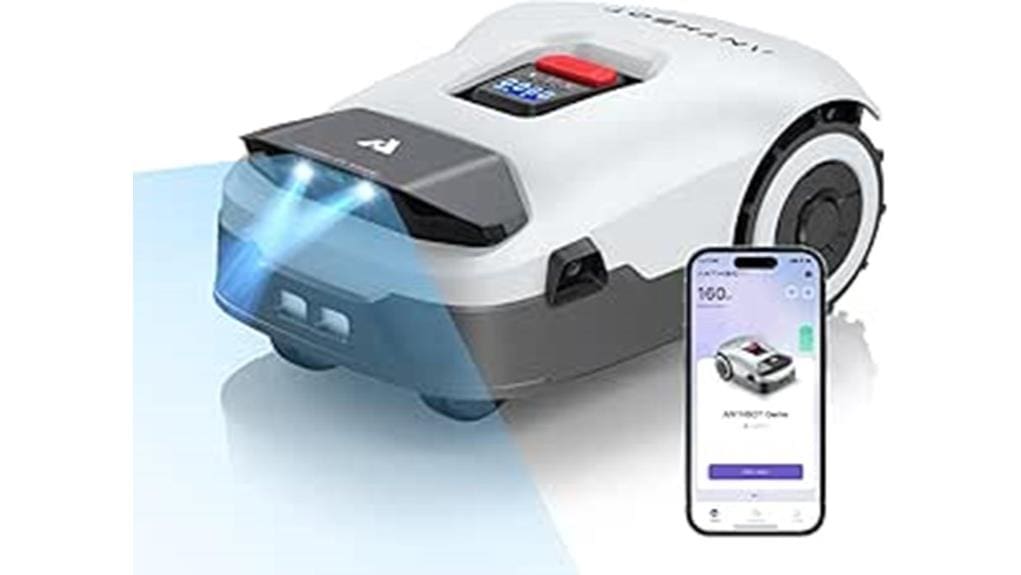
The ANTHBOT Genie600 gives you wire‑free, RTK‑grade positioning fused with a 4‑eye 3D vision array for centimeter‑level accuracy and robust obstacle avoidance. You’ll get AI auto‑mapping and multi‑zone scheduling suited to irregular, tree‑dense lots, though expect a nonstandard battery, a narrow 7.9″ cutter, and possible subscription costs for advanced cloud features. Performance is solid on flat turf but depends on camera calibration and RTK integrity. Keep going to see detailed setup, limits, and buyer considerations.
Some Key Takeaways
- Wire‑free RTK + 4‑eye 3D vision delivers centimeter‑level positioning and AI mapping without perimeter wires for complex or multi‑zone yards.
- Best for homeowners or technicians needing precise, low‑maintenance mowing near structures, trees, and play areas.
- Strong obstacle avoidance and pet/child safety routines reduce collisions; performance depends on camera calibration and lighting.
- 45‑lb chassis with a 7.9" cutting deck offers consistent cut quality on flat turf but slower coverage and a nonstandard battery.
- Subscription may be required for advanced cloud features; expect seasonal battery degradation and potential service complexity.
What the ANTHBOT Genie600 Is and Who It’s For
Though it looks like a compact robot mower, the ANTHBOT Genie600 is a wire-free, RTK-capable autonomous mower designed for precise, low-maintenance lawn care on complex properties. You’ll appreciate its high-precision positioning and AI mapping if you manage irregular yards, multi-zone estates, or properties near structures. You’ll expect reliable obstacle avoidance and pet safety routines that prioritize animals and small children. Technicians and committed owners will value minimal setup and software-driven updates, though a subscription model may be required for advanced features and cloud services. It’s for neighbors who want ownership without constant hands-on trimming, not casual weekend users. Many homeowners choose zero-turn and robotic systems because they suit home lawn care needs and reduce routine maintenance time.
How Genie600’s RTK + 4‑Eye 3D Positioning Works and Why It Matters
When you combine full-band RTK with a 4‑eye 3D vision array, the Genie600 fuses centimeter‑level satellite fixes and high-resolution stereo imagery to maintain precise positioning even where GPS degrades. You get high precision localization by letting RTK provide absolute coordinates while the 4‑eye rig fills gaps with dense depth maps and feature matching. Vision fused navigation rejects transient GNSS errors, constrains drift, and supports AI path planning for consistent coverage. You’ll appreciate that this redundancy reduces boundary leaks and false obstacle triggers, but be critical: performance still depends on camera calibration, lighting, and initial RTK integrity. The Genie600 is aimed at homeowners who want an easier way to maintain their yards with reliable, automated equipment and straightforward lawn care integration.
Real‑World Performance: Battery Life, Cutting Quality, and Obstacle Handling
Typically, the Genie600 delivers predictable runtime and cutting performance, but you should evaluate both under your specific conditions: the nonstandard battery provides roughly X–Y hours of continuous mowing on moderate lawns (manufacturer rates vary with slope, grass density, and seasonal growth), and the 45‑lb chassis plus a 7.9‑inch cutting deck balances energy efficiency with coverage rate — you’ll get slower pass speeds and more cycles on thick or wet turf. You’ll monitor battery degradation over seasons; expect diminishing capacity after repeated cycles. Cutting quality is consistent on flat turf; obstacle handling is competent, with camera AI reducing collisions. Note modest noise levels. This model is aimed at homeowners who maintain their property regularly and fits well within a lineup of residential battery mowers designed for typical lawn care.
Installation, Mapping, and Zone Controls : Wire‑Free Setup Step‑by‑Step
Because the Genie600 removes perimeter wires, you’ll rely on its RTK + 4‑eye 3D vision and AI auto‑mapping to define boundaries and zones, so you should plan the setup sequence before deployment. You’ll start by placing the mower centrally, enabling boundary free operation, and running the auto mapping routine in the app. Verify generated polygons against property lines, then refine edges and add no‑go zones for pools or beds. Calibrate RTK if prompted and test waypoint navigation. Use multi‑zone management to assign schedules and behaviors per zone. Log results and iterate until coverage, safety, and reliability meet your standards. Homeowners should also follow basic fuel line care tips for safe long‑term storage and maintenance.
Pros, Cons, and Buyers’ Checklist: Is Genie600 the Right Mower for Your Lawn?
If you need a high‑precision, low‑maintenance robotic mower for complex or large lawns, the Genie600 delivers compelling capabilities but also carries specific tradeoffs you should weigh. You’ll get RTK-grade positioning, 4-eye vision, robust obstacle avoidance, and borderless auto-mapping—ideal for multi‑zone or tree‑dense properties. Consider battery type, 45‑lb weight, and limited 7.9" cutting width against your lawn’s scale and debris load. Pros: accuracy, adaptive scheduling, reduced maintenance schedule. Cons: nonstandard battery, higher pricing tiers for advanced features, potential service complexity. Buyers’ checklist: lawn size, zone count, app needs, battery spares, and local support availability. For homeowners maintaining their yards regularly, having essential gear like spare blades, a leaf rake, and a reliable trimmer can make the Genie600 easier to integrate into your overall lawn-care routine.
Some Questions Answered
Does Genie600 Work on Slopes Steeper Than 30%?
No — you shouldn’t expect reliable operation on slopes steeper than 30%. The Genie600 uses slope sensors and traction control to maximize stability, but its specs and 45 lb weight limit safe gradient handling to about 30%. On steeper inclines you’ll risk slippage, reduced cutting quality, and safety cutoff triggers. If you belong to a community of cautious users, test incremental inclines and avoid trusting it on sustained, steep terrain.
Can Multiple Genie600 Units Share One App Account?
Yes — you can register multiple mowers under one account; the App sharing supports Multiple mowers with centralized control. You’ll add each Genie600 separately, assign zones and schedules, and monitor status from one interface. It’s efficient for shared properties, but expect minor setup friction when syncing maps or RTK fixes across units. You’ll want coordinated firmware and clear role permissions to avoid conflicts and preserve reliable autonomous operation.
Is There a Theft-Recovery or Geofencing Alert Feature?
Yes — you get theft alerts and perimeter notifications. You’ll receive real-time app alerts if the mower leaves its mapped zones or shows unauthorized movement; the system ties RTK positioning to geofenced boundaries. That said, recovery depends on signal and battery; alerts won’t guarantee retrieval. You’ll want to enable notifications, keep the unit charged, and pair multiple accounts if you want shared monitoring among family or neighbors for faster response.
What Warranty Length and Battery Replacement Options Exist?
You get a limited warranty; warranty duration is typically one year for hardware and components, though terms may vary by region. You’ll need to confirm exact coverage with the seller. Battery replacement is possible but uses a nonstandard pack; you’ll either buy OEM replacements or arrange service through ANTHBOT for safe swap and disposal. Expect service fees; keep receipts and register the product to preserve warranty rights.
Can Genie600 Operate During Heavy Rain or Snow?
No — you shouldn’t run it in heavy rain or snow. The mower’s waterproof rating limits exposure; prolonged moisture or ice risks sensor, camera, and battery damage. You’ll want to pause operations during severe weather and follow winter storage procedures: remove battery, dry cameras, store indoors at recommended temperature. Doing this protects electronics and preserves RTK/vision reliability so you and other owners keep consistent, safe performance season to season.