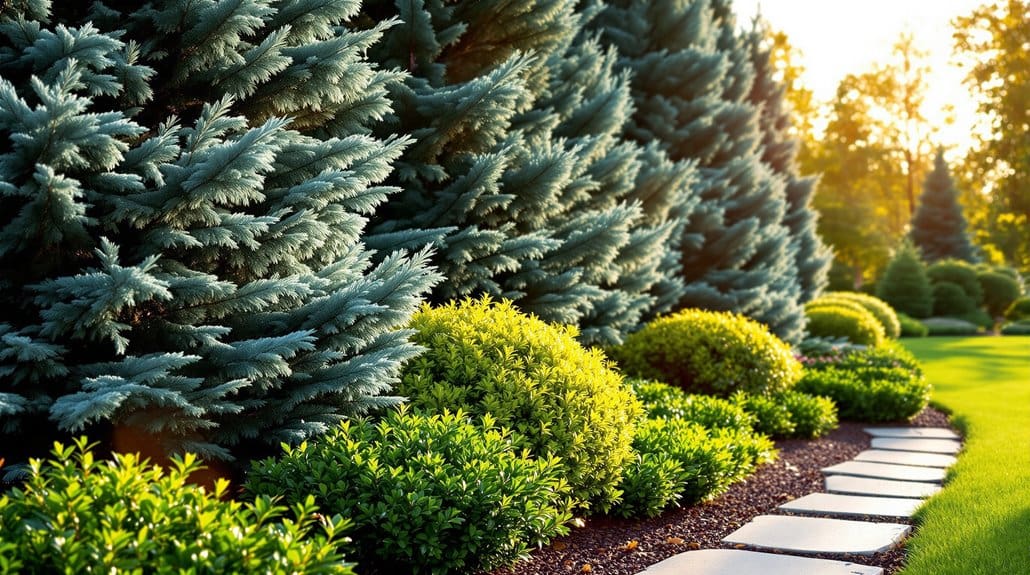
You want year-round curb appeal, so start by matching plants to your zone and site—don’t plant tender hollies in an exposed bed and expect miracles. Use columnar arborvitae or narrow yews for privacy, compact boxwood or inkberry for tidy edges, and add a few flowering or berried evergreens for winter color. Mulch, water deeply before freeze, and space to mature; prune lightly each spring. Now follow these steps and you’ll see steady improvement, with more tips ahead.
Some Key Points
- Choose a mix of tall narrow evergreens (North Pole arborvitae, Stonehenge yew) for year-round screening and vertical structure.
- Use compact shrubs (Sprinter boxwood, Gem Box inkberry, Tator Tot arborvitae) for neat foundation plantings, borders, and container accents.
- Match species to your USDA zone, microclimate, and sun exposure to prevent winter dieback and stress.
- Group plants by light, soil pH, and mature size to avoid crowding and ensure long-term health and uniform appearance.
- Add berry-producing broadleaf evergreens (Castle Keep holly, inkberry) and varied textures for winter color and wildlife interest.
Choose Evergreen Shrubs by Purpose: Screening, Foundation, Border, or Container
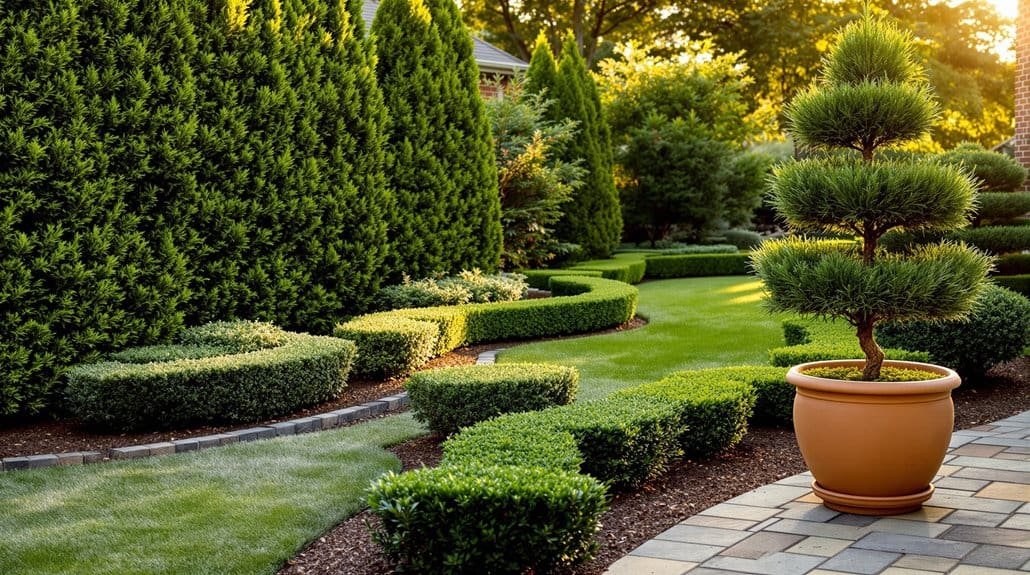
Start by thinking about what you want the plant to do, because picking the wrong shrub is where most of us trip up — I've buried more overgrown hedges in my yard than I'd like to admit. Step 1: decide the role. For screening, pick tall, narrow evergreen shrubs like North Pole® arborvitae or Stonehenge® yew that give year-round privacy without constant shaping. Now, foundation plantings should be moderate, neat, low-maintenance—Castle Keep® blue holly or Gem Box® inkberry hold 2–5' and look tidy. Something worth pondering: borders need compact, dense types like Sprinter® boxwood or Tortuga® juniper for clean edges. Containers want slow-growing, container-friendly choices such as Tator Tot® arborvitae or Sprinter® boxwood, with well-draining soil and steady water. Consider also choosing shrubs that match your maintenance preferences and space, like low-maintenance varieties commonly recommended by lawn care equipment and landscaping resources.
Match Plants to Your USDA Zone and Light: Avoid Winter Surprises
Now first check your USDA zone so you’re not guessing—pick evergreens rated for your zone (for example, Thuja for cold areas or Gardenia for warmer spots) to avoid the heartbreak of winter dieback. Next, assess the light where you plan to plant, because sun-loving Juniper needs six-plus hours while shade-tolerant boxwood and inkberry will keep their leaves under taller trees; do this, don’t plant sun plants in deep shade. Something to mull over: size at maturity matters for hedges and borders, so choose cultivars that won’t crowd themselves into weak, shaded centers that winter will punish. Also consider soil pH and amendments like lime to give the plants the proper nutrient availability and long-term health.
Know Your USDA Zone
Think of your USDA hardiness zone as the cheat sheet that keeps your evergreens alive through their first brutal winter—get it wrong and you’ll learn the hard way, like I did when a supposedly “pretty tough” boxwood went limp after a cold snap. Step 1: find your USDA hardiness zone, then match plant tags to those Hardiness Zones, don't guess. Now pick cold-hardy cultivars if you’re on the edge, or plan mulch and windbreaks. Step 2: note each plant’s exposure range, since light and cold interact—what survives in a sheltered corner may die on an exposed ridge. Something to bear in mind: microclimates on your lot matter, so choose plants that fit both zone and sun conditions, not hopeful wishful thinking. Also consider maintenance needs and equipment — like choosing the right mower for regular care — when selecting plants for year-round interest, and learn about lawn care equipment to match your yard’s needs.
Assess Sun And Shade
You’ve matched plants to your hardiness zone, which is great, but sun and shade are the next make-or-break step for winter survival — I learned that the hard way when I planted a “shade-tolerant” boxwood into what I thought was partial sun and came back to a crispy mess after a cold, windy week. Now, check your USDA hardiness zone again, then map sun exposure across the site, measuring hours so you know full sun to full shade spots. Something to keep in mind: south- and west-facing beds dry out faster and need drought-tolerant choices, while north-facing shade stays moist. Do this: group species with similar light and zone needs, avoid mixing sun lovers with shade lovers, and protect exposed plantings from winter wind. Consider adding essential tools like a pH test kit to monitor soil conditions and keep plantings healthy year-round, especially when adjusting for moisture and nutrient needs soil testing.
Choose Zone-Appropriate Evergreens
If you want evergreens that actually survive your winters, start by matching plants to your USDA zone and the light they’ll get—don’t guess and don’t plant a warm-climate beauty where it’ll get blasted by cold and wind. Step 1, check your USDA hardiness zone, pick cold-hardy choices like Thuja or hardy rhododendrons for tougher winters, not tender oleander. Step 2, match light: use sun lovers such as Juniperus in sunny beds, and shade-tolerant broadleaf evergreens like boxwood where sunlight’s scarce. Something to ponder: for small or constrained sites, choose compact cultivars, Tator Tot or Gem Box, so snow and wind don’t overwhelm them. Do this, not that—plan for pollination with dioecious hollies, and avoid winter surprises. Many gardeners also consider soil health when choosing plants and fertilizers to support long-term vigor.
Select Durable Winter Performers: Conifers and Cold-Hardy Broadleaves
Now pick cold-hardy conifers like Thuja 'North Pole' or Juniperus chinensis for tall, reliable screens, and pair them with tough broadleaf evergreens such as Ilex 'Castle Keep' or inkberry for glossy winter foliage and berries. Something to keep in mind: site plants where they get afternoon sun, good drainage, and shelter from prevailing winds so you won't regret a plant dying back in your first hard winter—been there, learned that. Do this, not that: choose species rated for your USDA zone and mix needle-bearing and berry-producing evergreens for structure, wildlife value, and low fuss. Consider planting and maintaining them with proper lawn equipment to ensure healthy establishment and low maintenance.
Cold-Hardy Conifer Choices
Because winter can be the toughest test for your landscape, start with plants that won’t sulk the first hard freeze—pick cold-hardy conifers and a few sturdy broadleaf evergreens that stay reliable year after year. Step 1 — Choose proven backbone: Arborvitae give tall, narrow screening, like 'North Pole', great when you need privacy without fuss, they stand to zone 3. Step 2 — Fill low spots: cold-hardy junipers, such as 'Tortuga', make drought- and deer-resistant groundcovers, low-mounded and hardy even to zone 2. Step 3 — Add shade-tolerant verticals: Taxus x (yews) like 'Stonehenge' give long-lived, columnar accents for tight screens. Something to bear in mind: small-space dwarf forms save you pruning headaches and keep Winter Interest without drama. Consider pairing these staples with essential lawn and garden gear for homeowners to make planting and seasonal care easier.
Tough Broadleaf Evergreens
Tough-plant thinking will save you a lot of winter headaches: pick broadleaf evergreens that stand up to cold, dry winds, and the occasional meandering deer, and you’ll have reliable color and structure when everything else goes gray.
Step 1 — Choose reliably hardy types you can live with. Go for cold-hardy broadleaf evergreens like inkberry or holly, they keep glossy green foliage and need little pruning, unlike some tender azaleas that taught me a lesson. Now, ponder deer resistance and drought tolerance; inkberry and some junipers are forgiving. Something to weigh: match hardiness ratings to your zone, and favor plants that give year-round color and privacy without constant fuss. Do this, not that: pick toughness over trendy fragility.
Site-Specific Planting Tips
If you want winter interest that actually lasts, start by matching the plant to the spot—select hardy conifers like North Pole® arborvitae or a tough juniper for backbone, and mix in cold‑tolerant broadleaf evergreens such as Castle Keep® holly or Sprinter® boxwood for texture and privacy, because variety keeps you from losing everything to one pest or a brutal cold snap. Now, pick species rated at or below your lowest winter temperature, place sensitive broadleaf evergreens in sheltered microclimates, and aim for mixed plantings so one problem won’t wipe out your whole yard. Something to take into account: install in well‑drained soil, water deeply before freeze, and use Mulching (2–4 inches) to protect roots, improve evergreen foliage and guarantee reliable Privacy screens.
Compact Evergreens for Low Hedges and Pathways (Sprinter, Gem Box, Tator Tot)
Now let’s lay out a simple plan for edging and low hedges using three compact evergreens that actually do what they promise — Sprinter boxwood, Gem Box inkberry, and Tator Tot arborvitae. You’ll plant Sprinter,Gem Box,Tator Tot for low hedging to get glossy form, dark density, and soft conifer contrast; that mix gives a friendly, steady rhythm along paths. Start by spacing plants 12–24" apart based on mature width, use well-drained soil, and water regularly while they settle in. Prune lightly to keep a clean edge, don’t shew them into bonsai shapes — been there, looked odd. Now, if shade’s a problem, favor Gem Box; for tiny containers, choose Tator Tot. Something to ponder: Sprinter tolerates sun or shade, it’s forgiving.
Vertical and Screening Choices for Privacy and Narrow Spaces (North Pole, Sky Box, Stonehenge)
When you need height and privacy but have only a narrow strip to work with, choose a slim conifer or holly and plant it in a rhythm that matches its mature width, not your wishful thinking; that’s the mistake I keep learning from. Start by picking species that fit your site: North Pole arborvitae gives a tall 10–15' conical privacy screen at 3–5' wide, Sky Box Japanese holly offers a tighter 4–5' column at 2–3' for formal hedges, and Stonehenge yew handles deep shade while staying a slim 8–10' tall. Now space North Pole or Stonehenge 3–5' apart, Sky Box 2–3' apart, and prune lightly to keep neat lines. Something to bear in mind: trust mature size.
Flowering Evergreen Accents for Seasonal Interest (Perfecto Mundo, Dandy Man, Steady as She Goes)
Add a few flowering evergreens and you’ll get color through seasons, not just a single show—trust me, I’ve learned the hard way that matching plant size to place matters more than wishful thinking. Step 1: pick roles. Use Perfecto Mundo azaleas for low, repeat spring-to-frost color, they top out near 30", so don’t plant them where a taller shrub belongs. Step 2: set the backbone. Dandy Man gives you a taller screen, purple clusters over dark green foliage, hardy and stately, perfect where you need height. Step 3: add scent. Steady as She Goes gardenia brings glossy leaves and intense fragrant blooms, so place where you’ll enjoy the smell. Now, plant in acid, well-drained soil, water reliably, and avoid crowding.
Textures, Colors, and Groupings That Read Well in Winter (Foliage Contrast and Massing)
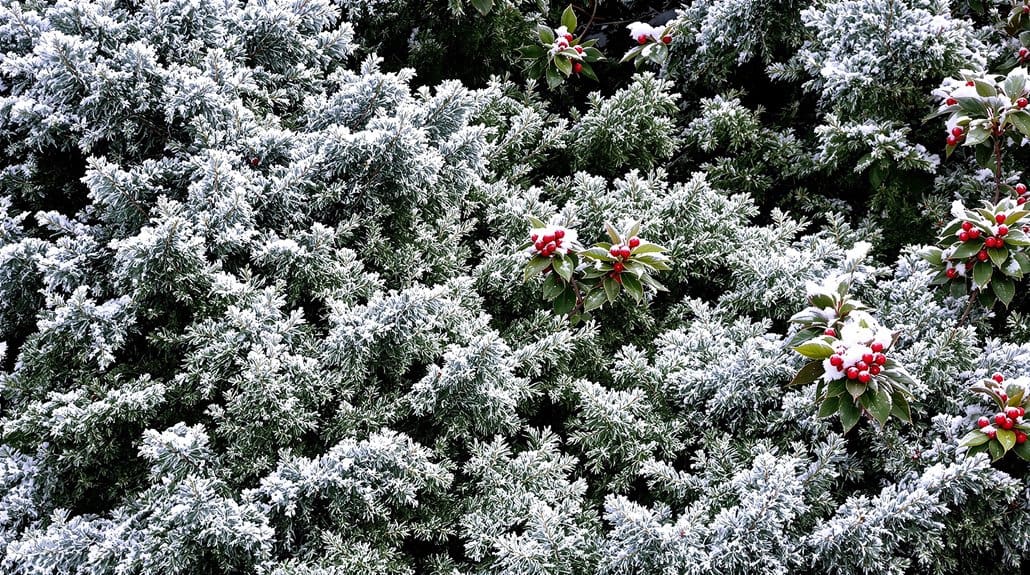
You’ll often get the cleanest winter look by thinking of texture and color the same way a painter thinks of brushstrokes: place fine-textured shrubs like Sprinter® Boxwood and Sky Box® Japanese Holly against coarser plants such as Gin Fizz® Juniper to make each form read at a distance, and you’ll avoid the muddled, “too many things” mistake I used to make. Now, do this: mass blue- or gray-toned evergreens next to gold-edged Gold Splash® Euonymus so contrast foliage color pops, and plant large swaths of one type so the yard reads from afar. Something worth pondering, group plants in odd-numbered clusters, stagger textures and sizes—low mounds, mid masses, tall accents—for permanent foliage all year.
Planting, Mulching, and Winter Care to Prevent Desiccation and Salt Damage
Start early and give your evergreens the best chance at lasting beauty by planting in spring or early fall, spacing them for their mature size so roots can settle without extra stress—trust me, I learned the hard way by crowding boxwoods too close and watching winter take its toll. Step 1: plant with room, water deeply about an inch weekly through late fall so roots enter dormancy hydrated, not hungry. Step 2: apply 2–3 inches of organic mulch in a 2–3 foot radius, keep mulch 2–3 inches from stems, it conserves moisture and steadies soil temps. Now, prevent salt damage by choosing salt-tolerant species near roads, add a 3–5 foot buffer or barrier, flush salts in spring. Something to keep in mind: spray anti-desiccant for broadleaf evergreens, and screen from driving winds.
Low-Maintenance Pruning and Replacement Strategy to Keep Structure Year-Round
When you treat pruning as gentle sculpture instead of a haircut, your evergreens will keep the shape and strength that make a yard look finished year-round.
Now, prune slow-growing broadleaf evergreens lightly in late spring, removing no more than a third so boxwood and holly keep their natural form; don’t hack. Next, schedule annual formative cuts for columnar types like Sky Box and North Pole in early spring, trimming lateral shoots 6–12 inches to keep height without thinning. Something to ponder: shear dwarf mounds once a year and spot-replace any thinning plants, matching cultivar and rootstock. Be practical—plan on replace-as-needed by planting 10–20% extra for hedges. Maintain health with deep water, 2–3 inches of mulch, and spring fertilizer to avoid heavy corrective work later.
Some Questions Answered
How Do Evergreens Affect Nearby Utility Lines and Gutters?
Want to protect your lines and gutters? Your evergreens can cause branch interference, needle buildup, root proximity issues, and extra snow load, so trim branches away from wires, clean gutters often, and keep large roots at a distance. Now, prune correctly, not just hack at trees—call a pro for wires. Something to keep in mind: mulch instead of piling soil around trunks. You’ll feel proud, and avoid costly repairs later.
Can I Mix Evergreen and Deciduous Roots Without Competition Problems?
Yes — you can mix evergreen and deciduous roots, with care. Now, test root compatibility, choose species that share soil needs, and plan soil layering to give shallow and deep feeders their own zones. Something to keep in mind: install rhizome barriers where aggressive roots invade, and manage water competition with targeted irrigation. Do this, not that: don’t crowd plants, and don’t skip mulch. You’ll learn, I have — and you’ll succeed.
Will Evergreens Increase My Home’s Resale Value?
Yes — studies show homes with strong curb appeal can sell up to 10% faster, and evergreens help. Now, plant them for privacy screening, choose low-maintenance species to keep maintenance costs down, and locate them for summer shade to gain energy savings. Something to ponder: don’t overplant like I once did; thin and shape instead. Here’s what to do now, pick durable varieties, space them right, and budget modest upkeep.
Do Any Evergreens Attract Pests Harmful to Pets?
Yes — some evergreens can harm pets, so don’t assume all are safe. Now, check labels for toxic sap and needle ingestion risks, and avoid species that attracts rodents or leads to ant nesting near bases. Something to keep in mind: mulch away from trunks, trim low branches, and swap dangerous plants for pet-safe varieties. You’ll learn as you go, you’ll make mistakes, but these steps will protect your pets and calm your worry.
How Soon Can Newly Planted Evergreens Be Trimmed for Shape?
You can trim newly planted evergreens after they’ve set roots, usually 1–2 growing seasons, shorter for fast growers, longer for slow ones. Now, follow timing guidelines: prune in late winter or early spring for shape, avoid heavy cuts in summer. Take into account growth habit, cut back to live wood, use sharp pruning tools, clean blades. Something to keep in mind: don’t shear too soon, you’ll thank yourself later.